




At the 2026 European CAR-T conference in Palma de Mallorca, researchers presented new data suggesting that CAR-T cell therapy — originally developed to treat cancer — may also offer a promising approach for severe autoimmune diseases.
The therapy works by collecting a patient’s own T cells and genetically modifying them so they can target CD19-positive B cells, which play a key role in many autoimmune disorders. After reinfusion, these CAR-T cells eliminate the harmful B cells, leading to deep B-cell depletion. Researchers believe this process may allow the immune system to rebuild itself, creating what some scientists call an “immunological reset.”
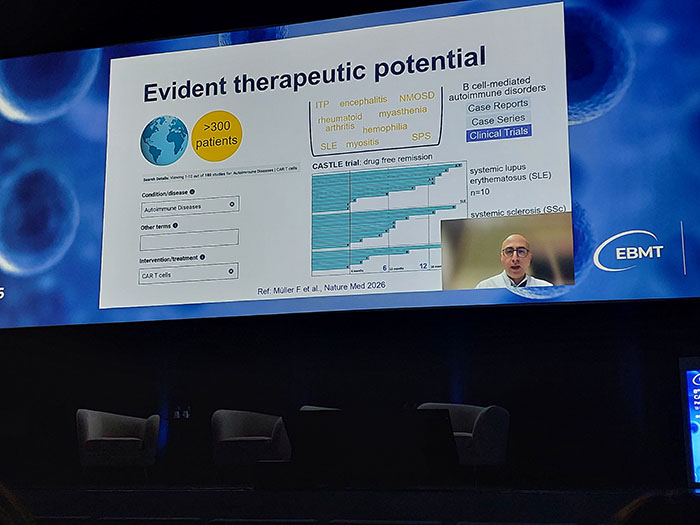
Presentation on CAR-T therapy for autoimmune diseases at the European CAR-T Meeting (EBMT), Palma de Mallorca, 2026.
So far, more than 300 patients worldwide have received CAR-T therapy for autoimmune diseases in case reports, case series, and early clinical trials. Conditions under investigation include systemic lupus erythematosus (SLE), rheumatoid arthritis, myasthenia gravis, systemic sclerosis, and other immune-mediated disorders.
Early studies have shown encouraging results, with some patients achieving drug-free remission, particularly in severe lupus cases that did not respond to conventional treatments.
However, experts at the conference emphasized that the field is still developing. Some patients experience relapses, and larger randomized trials are needed to better understand long-term outcomes and optimal patient selection.
Several clinical trials are currently underway, and researchers expect the first registration-enabling studies within the next few years, potentially bringing CAR-T therapy closer to clinical use for autoimmune diseases.
Publication date: March 2026

