





MRD stands for Minimal Residual Disease. It refers to the very small number of myeloma cells that may remain in the body after treatment — even when standard tests show complete remission.
In multiple myeloma, a patient may achieve a complete response (CR), meaning that routine blood tests and bone marrow examinations no longer detect visible cancer. However, highly sensitive testing may still identify tiny amounts of remaining disease. This is called MRD.
How Is MRD Measured?
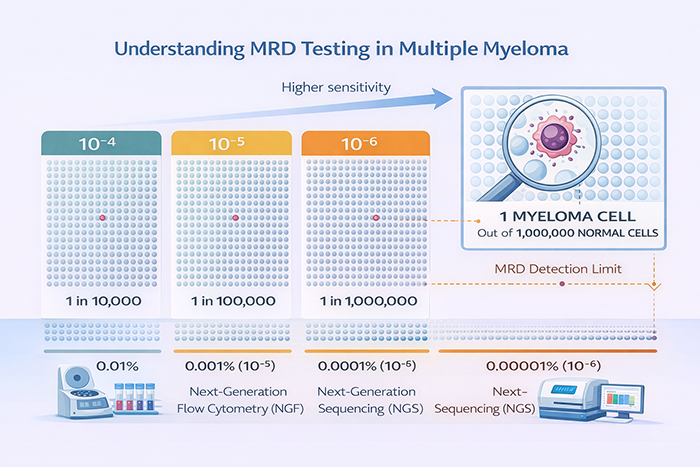
MRD is assessed using advanced laboratory technologies such as:
- Next-generation flow cytometry (NGF)
- Next-generation sequencing (NGS)
These methods can detect one myeloma cell among 100,000 to 1,000,000 normal cells. This level of sensitivity allows doctors to evaluate how deeply a treatment has worked.
Why Is MRD Important?
MRD status is one of the strongest predictors of long-term outcome in multiple myeloma.
- MRD-negative patients (with no detectable disease at very sensitive testing levels) generally experience longer progression-free survival and longer overall survival.
- MRD-positive patients have a higher risk of relapse.
For this reason, modern myeloma treatments aim not only to achieve remission, but to reach MRD negativity, which is associated with better long-term disease control.
MRD and Advanced Therapies Such as CAR-T
Innovative treatments, including CAR-T cell therapy, have significantly increased the rates of deep responses and MRD negativity in patients with relapsed or refractory myeloma.
CAR-T therapy uses the patient’s own immune cells, which are genetically modified to recognize and attack myeloma cells. In many cases, this approach leads to profound tumor reduction, and a substantial proportion of patients achieve MRD-negative status.
While multiple myeloma is still generally considered a chronic condition, the ability to achieve sustained MRD negativity represents a major advancement in treatment outcomes.
For international patients exploring advanced treatment options, access to therapies that can achieve deep, MRD-negative responses may play an important role in long-term disease management.
Publication date: Feb 26, 2026.

